Whoa. No updates since July 22. Yikes.
No, I haven't fallen off the map. I'm still here and still writing. Unfortunately, however, the site has fallen. Fallen on my priority list, that is. There's plenty going on around here, and plenty to come on the site.
Nevertheless, I'm trying to give everything my full 100%. And if I seem slack off or fade away after only about 90% or so, maybe it's just the lingering immaturity. Which is a perfect lead into the next paragraph...
Here's a link to my latest column. Or here's the printable version.

Friday, August 14, 2009

Wednesday, July 22, 2009
Stink and the Great Guinea Pig Express by Megan McDonald
 Stink Moody’s fourth adventure begins as he and his friends, Sophie of the Elves and Webster, are building the Great Wall of China out of cereal boxes. They only have one little mishap – a battle with Stink’s super-sticky duck tape. All three of them get stuck together! “Don’t worry,” says Stink, “Friends should stick together.”
But then they notice that the great wall is moving. Quivering. Shaking.
And … squeaking?
The three investigators discover three escaped guinea pigs. They decide to talk to Mrs. Birdwhistle at their favorite pet store, Fur & Fangs. When they arrive they find cages toppled! Escaped animals are everywhere! Puppies squeal, parrots squawk, rabbits race, and guinea pigs squeak from every corner of the room.
“Don’t just stand there,” said Mrs. Birdwhistle, “Help me catch them.”
After the escapees are once again corralled, Mrs. B. explains that the guinea pigs were being used in lab experiments, so she took them in, all 101 of them. Unfortunately, now she needs to find families to adopt them or they’ll be put to sleep, and she has no idea how to make it happen.
Luckily for her, she’s friends with Stink, Webster, and Sophie. They go door to door in the neighborhood. One man says he’d take fifty, but when they recognize him as Sam the Snake Man, they wisely decide against it.
That’s when they get the idea for the Great Guinea Pig Express – Squeals on Wheels! – a converted camper that houses the critters and makes a great traveling advertisement. After finding a few adoptive pet owners in a local parking lot, the Fantastic Fur Friends take a trip to Virginia Beach where a friend of Mrs. B’s has started a guinea pig rescue and has agreed to take twenty of guinea pigs. On their trip they stop at various points of interest (ever see the world’s oldest ham or a giant gorilla named Hugh Mongous?) to find more adoptive homes.
Filled with plenty of goofiness, like Stink’s crawling underwear and a guinea pig that looks like Chewbacca, Stink and the Great Guinea Pig Express is another fantastic addition to Megan McDonald’s tales of the Moody Family. Stink and Judy are welcome additions to every middle grade classroom.
Sunday, July 19, 2009
The Land of the Silver Apples by Nancy Farmer
 Jack’s sister, Lucy, is set to play an important role in the village’s need-fire ceremony, a rite intended to leave behind the evils of the old year and move into the new year with a fresh start. And the past year has had its share of evil, as readers will know from reading The Sea of Trolls, the first book in Nancy Farmer’s trilogy.
But when Jack’s father once again gives in to Lucy’s wailing, purposely permitting her to wear a forbidden necklace to the ceremony, Lucy allows old evil to creep into the new year. It spreads. It’s like a contagion, says the Bard, and it must be driven off before it affects everyone.
Giles Crookleg, Jack and Lucy’s father, then relates a story that he has kept hidden for years. After Lucy was born and her mother, Alditha, became sick, Giles took Lucy to the tanner’s wife for care. On the return trip he stopped to pick ripe hazelnuts, and while he was distracted, Lucy was kidnapped. But by some miracle, as he saw it, the child was replaced by another beautiful baby.
When seeking answers at St. Filian’s monastery, Jack’s unpolished bard skills cause an earthquake. In the ensuing chaos, Lucy (the one readers already know) is kidnapped by the Lady of the Lake, a close friend of the Queen of Elfland. The Lady also takes all the water from St. Filian’s well. Jack and Pega, a slave girl Jack recently freed, and another former slave named Brutus embark on a quest. Find Lucy. Find the replacement Lucy. Bring water back.
The second book of the trilogy introduces more mythical creatures. Jack and his fellow travelers encounter kelpies and a knucker hole and girl nearly buried in moss and even dragon poop. There are yarthkins and hobgoblins, including a king named Bugaboo and his Nemesis. And of course they travel to Elfland, meet elves, and learn the secrets behind the elves’ history and current lives.
Jack’s bard skills are growing, but as evidenced in the earthquake he causes, he’s far from being in control of them. Seeing Jack’s growth, both in character and skill, and the relationships he has with Thorgil – yes, she’s back for book two – and Pega, the freed slave girl, is a rewarding part of the book.
Overall The Land of the Silver Apples simply feels like the middle book of a trilogy. Lacking is the fresh shine and newness of the initial book and the anticipation created by an impending conclusion. If readers climbed a mountain in The Sea of Trolls, then The Land of the Silver Apples serves as a bridge to The Islands of the Blessed, where readers will embark on an exhilarating trip down to the (hopefully) fulfilling finale.
Thursday, July 16, 2009
Public Enemies by Bryan Burrough
 I wrote the following statement before I saw the movie, but nevertheless, at that time I naively believed my uneducated opinion to be true:
The book is better.
Now I’ve seen the movie and I must, to be honest and fair, revise the previous statement. It now reads:
Why even try? I mean really! To say “the book is better” is like saying “Dillinger robbed banks.” No kidding. The movie is to the book like your little brother’s piggy bank is to the Federal Reserve. Which one gives gangsters the bigger reward?
Yeah, that’s a bit more accurate.
I've been planning on seeing Public Enemies ever since it was announced the John Dillinger movie would be filmed in Wisconsin, and historical sites, including one in my hometown, were scouted as possible locations. Then late last summer I had breakfast at Little Bohemia Lodge in Manitowish, Wisconsin, site of a bungled FBI raid on Dillinger, Baby Face Nelson, and others. Before my biscuits and gravy arrived, I read the brief history of the lodge and the failed raid printed on my placemat.
But now I’ve read the book, which includes a bit more information than the placemat, and it is phenomenal. Painstakingly researched by author Bryan Burrough and incredibly detailed, Public Enemies: America’s Greatest Crime Wave and the Birth of the FBI, 1933-1934 is much more than another John Dillinger story. Readers learn the truth about numerous criminals of the time. For example:
Charles “Pretty Boy” Floyd gained national notoriety due to media speculation after the Kansas City Massacre, a crime he didn’t commit, and by spring of 1933 he had “withdrawn from bank robbing altogether, preferring to spend his days baking pies in his cousins’ kitchens.” (He didn’t, of course, retire as a baker.)
Bonnie and Clyde were far from the glamorized characters portrayed by Hollywood. Their crimes were small compared to their contemporaries – one bank robbery earned them only $80, another attempted job was on a bank that had been closed for weeks. Bonnie nearly died in a car accident, and as they became more notorious, “they gave up bathing and normal hygiene. Their clothes were dirty. They smelled.” Hardly glamorous.
Ma Barker, portrayed by J. Edgar Hoover as the criminal mastermind of the Barker Gang, was more interested in jigsaw puzzles than crime. (But died from an FBI bullet to the head nevertheless.)
George F. Barnes was a dreamer and a joker, a nervous man who sometimes vomited before bank jobs. He and his wife were behind the kidnapping of Charles Urschel and the $200,000 ransom, but he missed the first cash drop, probably because he flooded his car. The most impressive part of his legacy may be his nickname: Machine Gun Kelly.
It has been said that truth is stranger than fiction. Public Enemies shows that truth can be better than fiction. Hollywood would be hard pressed to concoct a cast of characters with stories as interesting and intertwined as those on both sides of the 1933-1934 War on Crime. In fact, even when Hollywood is presented with a golden story in an open vault, it still makes off with only a buck-two-eighty. (For more thoughts on the movie, click here.)
Public Enemies: America’s Greatest Crime Wave and the Birth of the FBI, 1933-1934 is not to be missed. While the movie includes plenty of high speed chases and shoot-em-ups, the book explains how they managed to rob banks, as Dillinger once said, in “one minute, forty seconds. Flat.” It explains how the gangs were able to repeatedly evade the law, and especially how the FBI, just a fledgling organization being created on the fly to fight the War on Crime, often times made it easier for the gangs to remain free. Public Enemies is an eye-opening view through the bars of a life of crime and into the offices of the men trying to fight it.
Friday, July 10, 2009
Traveling? Time to Pack
Summertime means vacation time. New newspaper column today about going away, or more accurately, getting ready to go away.
Make sure you've got everything and the van is properly loaded, the click on over for the article or the printable version.
Thanks for reading.
Make sure you've got everything and the van is properly loaded, the click on over for the article or the printable version.
Thanks for reading.
Tuesday, July 7, 2009
The Sea of Trolls by Nancy Farmer
 Life couldn’t be more boring for Jack. He helps his father, Giles Crookleg, tend to the farm, wishing his hard work and dedication would be acknowledged, all while listening to his father’s never ending sing-song for his younger sister, Lucy, lost princess of a faraway land.
Right. Jack works his tail off for nary a thank you, while Lucy does exactly the opposite of what father asks with no consequences. Jack’s fortunes turn when the local Bard asks Jack to be his apprentice. After initially refusing, Giles Crookleg grudgingly agrees, encouraged by the Bard’s promise that Jack will have no fun, that he will “work like a donkey in a lead mine,” and that other village boys will come to aid with the farm.
Jack learns from the Bard to see the world differently, the beginning of his study of the life force, and the ability to call upon it for magic. His studies are unfortunately cut short by the attacks of vicious Northmen – Vikings – who kidnap him and Lucy. Jack is to be sold as a thrall (slave) and Lucy is to be a gift for Queen Frith, a half-troll, from Thorgil, a shield maiden seeking the queen’s approval.
Olaf One-Brow, the leader of this band of Northmen, decides to keep Jack as his own when he learns of Jack’s bard training. His own personal skald, a bard to create songs praising his abilities, ensuring his fame will never die.
Eventually, Olaf and his crew, Thorgil the shield maiden, Jack, and the crow Bold Heart are sent on a quest to drink from Mimir’s Well. Drinking the song-mead from the well is the only thing that will help Jack save Lucy. They travel to Jotunheim, land of the trolls, and face giant spiders, dragons, a troll-bear, and a deadly, frozen landscape. Oh yeah. And trolls.
I was astounded at how many times the actions of Olaf One-Brow and his band of berserkers disgusted me, only to find myself liking Olaf, sometimes even feeling sympathetic toward him, and sometimes even in the very next chapter. Then, when once again reminded of Olaf’s true nature, I found myself surprised! At least I shared these feelings with Jack, who, despite his growing abilities as a bard, hasn’t completely grown accustomed to this way of life, seemingly the opposite of that on his sheltered family farm.
Nancy Farmer has created an entire new world, complete with history and politics, all based on real history and legend. In fact, three pages of sources are listed about Norse myths, legends, and history. Readers will be quickly drawn into this historical fantasy world inhabited by characters with names like Ivar the Boneless, Gizur Thumb-Crusher, Einar the Ear-Hoarder, and Sven the Vengeful and creatures like jotuns (trolls), monstors, and various unclassifiables like half-ogres and shapeshifters.
I've had fourth graders read The Sea of Trolls with success, albeit strong readers, and know young adult readers eagerly antipating the release of The Islands of the Blessed, the conclusion of the trilogy. The Sea of Trolls is a remarkable book, with a wide interest level, that should be recommended to fans of the Inheritance Trilogy, the Percy Jackson series, the Wingfeather Saga, and The Lord of the Rings or readers ready to move on from series like the Spiderwick Chronicles and The Chronicles of Narnia.
Thursday, July 2, 2009
Odd and the Frost Giants by Neil Gaiman
 Neil Gaiman doesn't waste time - or words, more accurately - getting to the story of Odd and the Frost Giants, but readers won't miss the missing. Everything needed is there. Only the most talented authors are able to sift through the endless possibilities and present readers with no more than what's necessary. Gaiman fits the description.
In Chapter One readers learn of the boy, Odd. He is not unusual, as his name might suggest. Rather, it is a lucky name, Odd, meaning the tip of a blade. His life, however, has not been lucky. His Viking father had been killed in a sea raid. His mother, herself obtained in a Scottish sea raid, remarries a man named Fat Elfred. Odd permanently cripples his leg in a forest accident, and Fat Elfred has little use for a crippled stepson. That year, as winter hung on longer than usual and people’s dispositions changed for the worse, Odd left. He took his warmest clothes, food, and coals from the fire, and left for his father’s old woodcutting hut. Through it all and despite everything, Odd smiles.
I think that summary is nearly the length of the first chapter.
By the end of the next day, Odd has followed a fox, freed a trapped bear, realized he’s lost, feared his death by bear consumption, met an eagle, and returned to the woodcutter’s hut on the back of the bear. Oh, and he ends up with overnight guests.
It’s during the overnight stay when Odd learns there is more to his guests’ story. The bear, eagle, and fox are actually Thor, Lord Odin, and Loki, respectively. Gods. Inhabitants of Asgard who now find themselves exiles in Midgard, Odd’s world, thanks to the Frost Giants.
Thus the four begin a quest, traveling back to Asgard to free it from the hold of the Frost Giants. But Odd must travel alone to the Gates of Asgard, alone so the Frost Giants won’t learn of the gods’ return. Odd proves that a person’s circumstances in life are not just due to luck, and that gods returning to Asgard aren’t the only ones with a desire to return home.
Odd and the Frost Giants is a short book – the advanced reading copy is 117 pages – but what the story lacks in length is more than made up for in strength. Readers who enjoyed Coraline’s victory over her other mother and Bod’s survival against the man Jack will get similar satisfaction from Odd and his encounters with the Frost Giants.
Watch for Odd and the Frost Giants in September, 2009.
Tuesday, June 30, 2009
Mudshark by Gary Paulsen
 When each chapter begins with an all-school intercom announcement asking the custodian to report to the faculty restroom, you know the book is going to catch readers' attention.
When each chapter's custodial call gets progressively worse, from asking the custodian to bring "a shovel and a plunger" to "a rag, a strainer, and a set of tongs" to "a plastic shield, a hazardous waste suit and a large container of pepper spray" to finally "a Geiger counter, lead-lined gloves and smoked-lens goggles," all to the faculty restroom, well, who wouldn't want to discover the menacing cause of impending disaster?
What is somewhat confusing, however, is that the chapters themselves have nothing to do with the announcements, at least at first glance. The chapters tell the story of a young detective named Mudshark, so named for his quickness in Death Ball, a local sport that combines various aspects of soccer, football, rugby, wrestling, and mudfighting.
Mudshark is always thinking and always observing. So if you lost your homework, as Markie McCorkin once did, Mudshark could direct you to the bushes at the front of school to find the lost assignments, as he did for Markie. Because Mudshark sees things - Markie on the step, two small kids, a yellow ball, an orange folder, a red paper clip - and he puts them all together to solve the problems he’s presented. It's not rocket science. Just observation and memory.
But then the library's new parrot begins solving problems quicker than Mudshark. Sure, the parrot emits naughty noises and objectionable odors, recites off-color limericks in several languages, and says, "Hey, babe, what's happening?" but that doesn't stop the students from believing he's psychic. Mudshark knows better. It's not rocket science. Just observation and memory.
Mudshark is called in by the principal to help solve a mystery involving missing erasers in the school. Mudshark soon discovers the problem includes the custodian, the faculty restroom, a couple classmates, and a missing hamster. As he seeks to unravel the knots in this yarn, Mudshark must also keep the precocious parrot from getting in the way.
In the end Gary Paulsen brings everything together, including the cause of faculty restroom dilemma. The plot gets a bit confusing at times – I had to reread parts during my initial read – but it made much more sense as I reread it aloud to my class. My class wanted more description of the faculty restroom, but I think their imaginations actually drew more vivid and dangerous scenarios than would have been offered. We all wanted more Death Ball, more than the occasional mention of the playoffs or resulting injuries.
There’s still plenty of silliness to keep readers’ attention, with laughs on nearly every page, and an ending that elicits major groans and a great “Now what?!?”
Monday, June 29, 2009
Recognition Again?
 Any sort of confirmation that someone is actually reading your stuff is cool. It really is.
But to receive an award from a reader, to have someone personally sift through the gazillions of websites on the Internet and select yours as worthy of recognition, now that's something different.
Even if it's pink.
Now, I'm not against pink in general. It's a legitimate color, worthy of roses, pencil erasers, and raspberry sherbet. I'll even allow for it's migration into baseball, but only with good reason. But as an award, I must take issue. Awards should be shiny - gold or silver preferably - and tastefully named. Awards should not, to the best of my understanding, contain either flowers or teacups, unless said award is for an individual's talent or achievements in gardening and/or tea consumption. (Neither of which I am especially adept at.)
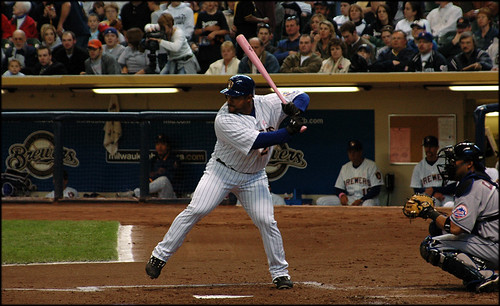
The links above reference actual trophies. Since it is difficult to email trophies, and impractical for blog award winners to display three dimensional objects on their websites, I'd like to display something else. Something that says, "Yes! That's what I'm talking about!" And yes, I'm allowing attitude to trump shininess in this situation. So if it's alright with Ms. Houghton's Class, who awarded me this distinction, I'd like to display the following picture to represent a more "me" feel.

So whaddya think? Will that work?
The last time I received an award I admittedly bent the rules of acceptance, choosing to look backward at worthy recipients rather than forward the award, so to speak. This time, well, "bending" the rules would be a generous description. I'm giving great thanks and a tip o' the hat (or a pump o' the fist, considering the above picture) to Shannon from Ms. Houghton's Class ... and that's it. I'm using books to read and posts to write as (hopefully) worthy excuses. So I tentatively accept the One Lovely Blog Award, recognizing that in order to do so one should follow the rules and probably not disrespect said award's pinky icon, and I pray that some sort of e-karma doesn't come back to get me.
Sunday, June 21, 2009
Scaredy-Cat Catcher by Betty Hicks
 Rocky gets his turn in the spotlight in Scaredy-Cat Catcher, the fourth book in the Gym Shorts series by Betty Hicks. Rocky has always been the best catcher in the league, no question, but on a routine play at the plate, his arm gets broken. End of season.
But that was a year ago. The new season has started, and Rocky is back at his starting position behind the plate. On the first play similar to when the injury happened, Rocky has the guy dead at home. All he has to do is make the tag. But at the last second he pulls his arm away to avoid reinjuring it.
The run scores.
After that disastrous game, Goose, Jazz, Rita, and Henry convince Rocky that it's all in his head. "Bugs on the brain," explains Jazz. They reassure him that it won't happen again. And they're right. The next game Rocky is confident. He won't even flinch! He knows it! When the winning run heads toward home, the ball arrives in Rocky's glove in plenty of time. All he has to do is tag him and the game is over, but . . .
The run scores.
Time for action! Rocky’s friends do all they can to retrain his brain and break his bad habit. They practice in the backyard, Goose sliding toward Rocky as he makes tag after tag. Rocky’s coach gives him words of confidence. Even Chops, Rocky’s skateboard riding bulldog, gets a lesson in.
Rocky has never quit in his life – that’s even how he got his name. His nickname comes from Rocky Balboa, another famous non-quitter. But can he get through this? At times, he doesn’t think he can.
And I have to mention one favorite scene. Rocky is planning to quit, hiding behind “I don’t want to quit. I have to. For the team.” His friends won’t let him. Goose and Rocky make a bet. If Goose can spit in a tulip ten feet away, Rocky plays one more game. What follows is one of the best demonstrations of expectorating in children’s literature, illustrations included. Goose hocks a loogie dead center. Plop!
Once again in the Gym Shorts series, friendship and teamwork win out. Four friends (and a bulldog) come to the aid of the fifth, helping him accomplish a goal he wouldn’t have been able to do on his own. Great sports scenes, great friends, and another great addition to the series.
Friday, June 19, 2009
Duck! Rabbit! by Amy Krouse Rosenthal
 I read this one by myself as soon as I got it and thought, “Oooo-kaaaay. Maybe on the second time through…”
Then I called over the resident 7-year-old. “Hey, Bud! Read this with me?”
Magic. Giggles. “Again, again!” Here’s how it went:
The Boy [reading]: “Hey, look! A duck!”
Me [reading]: “That’s not a duck. That’s a rabbit!”
The Boy [not reading]: Huh, huh, huh-huh, huh.
Later…
The Boy [reading]: “Wait. Listen. Did you hear that? I heard duck sounds. Quack.”
Me [reading]: “That’s funny. I distinctly heard rabbit sounds. Sniff, sniff.”
The Boy [not reading]: Huh, huh, huh-huh, huh.
And that’s how it went. He read the duck arguments, then I read the rabbit arguments, then he giggled. (Then I giggled.) Grown-ups are … we’re just so … grown up! Grown-ups don’t get it, or so my unscientific observations seem to indicate, but kids do, and that’s what matters. We’ve read it numerous times now, he keeps laughing, and his reading keeps getting more and more expressive. When he reads, “There, see? It’s flying!” he means it.
 Amy Krouse Rosenthal and Tom Lichtenheld have created another winner for the classroom. Duck! Rabbit! will work great as a partner read (just like Elephant and Piggie books). It also could lead into some great art projects centered on optical illusions or even entirely new books. Imagine this:
Kid One [reading]: “Hey, look! A vase!”
Kid Two [reading]: “That’s not a vase. That’s two kids lookin’ at each other!”
Kids One and Two [not reading]: Huh, huh, huh-huh, huh.
And finally, to wrap it all up (and really, would you expect anything less from me?), the all-time, greatest ever, classic Duck! Rabbit! debate:
Sunday, June 14, 2009
Calvin Coconut: The Zippy Fix by Graham Salisbury
 Calvin Coconut is a Trouble Magnet, that much we know, but in The Zippy Fix author Graham Salisbury shows us that while Calvin not only attracts trouble, he can cause his share too.
Sixteen-year-old Stella has arrived from Texas, and she’s starting to fit in. Calvin’s mom and sister surprise Stella with a new green dress. She’s been invited to a dance at the high school. She puts it on and…
Well, here’s Calvin’s reaction: “She looked pretty good, all right. The silky smooth dress was the deep color of a ripe watermelon. It somehow made Stella look like a nice person. ‘You look like … like … like a watermelon.’”
See? Trouble finds him. He meant to be nice! He recognized how nice Stella looked in her new dress and wanted to compliment her. He did! But unfortunately sixteen-year-old girls don’t appreciate comparisons to oblong-shaped over-sized fruit, and she too can play the insult game. “Stump. Peewee. Pygmy. Pip-squeak. Squirt. Half-pint. Elfie. Rump. Shrimp. Shorty. Midget. Which one works for you?” Stella asks.
Now is where Calvin creates trouble. Stella is allergic to cats. Cats? Calvin comes up with a plan, a way to fix Stella with help from Maya’s cat, Zippy. The Zippy Fix.
The results are extraordinary, way beyond Calvin’s expectations. And this is where readers learn even more about Calvin. He has a heart. Compassion. He wants to make things right with Stella by getting her the perfect birthday gift, but it’s going to take a little more than the $1.31 he has.
Calvin goes through great lengths to make up the difference including loans, recycling, odd jobs, Uncle Scoop, trouble with Tito, help from Ledward, and a lot of determination.
All for Stella. The girl who stole his bedroom. Who teases him endlessly. Who made him live in the garage. Who looks beautiful in a new green dress. That Stella.
Look for The Zippy Fix this September.
Friday, June 12, 2009
Happy Father's Day
It's a little early for Father's Day, but when the newspaper says your column appears on the second Friday of the month, you roll with it.
Fathers belong in a special category, one kids reserve for the greatest and the strongest, for those who know everything and can do anything. God. Superman. Dad.
My latest newspaper column appears today. Here's the regular version and the printable version.
Fathers belong in a special category, one kids reserve for the greatest and the strongest, for those who know everything and can do anything. God. Superman. Dad.
My latest newspaper column appears today. Here's the regular version and the printable version.
Thursday, June 11, 2009
The Mad, Mad, Mad, Mad Treasure Hunt by Megan McDonald
 Judy and Stink Moody's last book, The Holly Joliday, featured Christmas vacation. Now they are on vacation again, and it's definitely not winter. The Moodys are on their way to Vegetable Island! Or is it Artichoke Island? Judy knows. "You mean Ocracoke Island."
Stink doesn't care. "I just want to meet pirates and look at shipwrecks and see real gold and find treasure." When the ferry docks, Scurvy Stink and Mad Molly O'Maggot meet a real life pirate who informs them that Third Annual Pirate Island Treasure Hunt starts first thing in the morning. X marks the spot on their map. Unfortunately, X only marks the start of their hunt, not their desired destination.
Working their way around the island, Judy and Stink must solve clues to collect sixteen pieces o’ eight. The clues include rhymes, puzzles, codes, talking birds, and hidden signs. Judy and Stink also need to watch out for spies in the form of another brother and sister team they nickname Tall Boy and Smart Girl.
(There’s also a trip to the Crab’s Claw, a seafood restaurant on Ocean View Road, which incidentally, would have been my downfall. “Maybe the next clue is inside this crab cake!” [Chomp] “Nope.”)
The best part of the book is the interaction between Judy and Stink. Despite their light-hearted teasing and sibling name-calling, they really do work together. It’s pretty obvious that neither of them could succeed on their own, but together, they just might have a chance.
In the end the Moody’s hunt leads to more than treasure. They learn the truth about their closest competition and the value of teamwork and good friends.
Look for this latest Judy and Stink Moody adventure from Megan McDonald in August.
Tuesday, June 2, 2009
Beyond the Grave (The 39 Clues) by Jude Watson
 After Dan and Amy successfully send Ian and Natalie Kabra clue hunting in Kyrgyzstan and witness the "death" of a rival, they learned the location of their next clue. Egypt.
Cairo is where author Jude Watson picks up the Cahills' story. Amy and Dan's au pair, Nellie, is bargaining for spices in the marketplace, Dan is distracted by King Tut pencil sharpeners and mummy shaped flashlights, and Amy is trying desperately not to lose either person. But what are spices and kitschy souvenirs compared with an ancient Sakhet, the clue that led them to Cairo, in a shop window and an old nemesis nearly killing Dan on page two?
Yes, the action starts immediately and continues right up to the destruction described on the last page. The nonstop action takes them to an Ekaterina stronghold and an alligator infested island on the Nile. There are more museums - to Amy's delight and Dan's chagrin - and even the darkest depths of an ancient tomb. They run into Irina Spasky and Jonah Wizard again and meet an old friend of Grace named Hilary Vale. And the mysterious Madrigals finally make an appearance.
Dan is as funny as ever. When a salesman in a room filled with spangled belly dancing outfits asks, "You are looking for lovely costume?" Dan responds, "Not my color! But thanks!" Later he says they should check Queen Neferfarty's tomb for a clue. Amy is troubled by her inability to judge character. She's been hurt by Ian and Alistair and wonders if she'll ever stop being taken in and used by selfish people who act friendly.
Characters are beginning to grow and change too. Nellie is becoming more adept at tracking Cahills, namely Amy and Dan. Saladin enjoys more than red snapper. (Hummus anyone?) Irina Spasky has ... wait for it ... feelings?!? And tragedy in her past? (Oh sorry, not everyone is growing. Jonah Wizard, frustrated that he's unknown in northern Africa, comments in an international airport, "They don't know that I'm da bomb?" If anything he shows he's even whinier than we all originally thought.)
Amy and Dan are changing too. They had been told to trust no one. Now they are beginning to wonder, does that include Grace herself? The more the siblings learn about the Cahill clan, the more disgusted they become. What's more, Amy and Dan find themselves resembling their extended family more each day. Lying, cheating, stealing, double-crossing … is this what Grace prepared them to be? Is this who Grace really was?
Eventually Grace shows them her true colors, and leaves no doubt. She communicates with them from beyond the grave. OK, not really. But they do receive a personal letter and plenty of hidden/secret/coded messages that Grace had prepared for them before her death. Grace also shows them that the only way they can possibly win the Cahill quest for The 39 Clues is with her help.
But only if they can find it within themselves to trust her.
Wednesday, May 13, 2009
Little Oink by Amy Krouse Rosenthal
 Just like eating vegetables (Little Pea) and bedtimes (Little Hoot), cleaning the bedroom can be a major point of contention between parents and children. As Little Oink grumbles, “When I grow up, I’m going to let my kids clean up their rooms as much as they want."
His friends are allowed to clean their rooms. Socks neatly folded and organized by color. Blocks alphabetized. But not so in his house. Proper pigs know how to make a proper mess. His father can paint a picture and leave paint all over the floor. His mother can water the plants and manage to spill water and potting soil. There are half eaten sandwiches and piles of dirty laundry on the floor in Little Oink’s house.
He’d better get after it before his parents get angry. Bed? Unmade. Clothes? Unfolded. T-Shirt? Stained. He even dragged in some mud for good measure.
Good enough? “I still see toys in their bin, mister,” says his dad, “Please – Not another word until this room’s a total pigsty.”
Finally, finally, Little Oink manages to make a complete mess of things – to the great delight of his piggy parents. And finally, finally, he’s able to do what every little piggy wants to do:
Get out the broom. Get out the scrub brush. Don’t forget the wash basin. It’s time to play house.
While Amy Krouse Rosenthal and Jen Corace’s latest book probably won’t have kids organizing their sock drawers or scrubbing the floor, they will certainly get them (and their parents) giggling as they read the antics of Little Oink and his parents. And really, which one’s more important?
Monday, May 11, 2009
Swimming with Sharks by Betty Hicks
 After the first two Gym Shorts books featured Henry and Goose, Rita is now the main character in Swimming with Sharks. Four of the five friends – Rita, Henry, Jazz, and Rocky – are on the swim team. (Goose is still busy becoming the greatest soccer goalie ever.) When Rita reaches the end of the pool, Miss York, the swim coach, checks her watch and announces that Rita has earned a place on the Dolphins team. Yes! Dolphins are very cool fish. Sleek, smart, friendly, and fast. Perfect for Rita.
But when Rocky, Henry, and Jazz all become Sharks and Rita realizes that their meets are on different days, her opinion changes. Dolphins are stupid.
Rita knows it’s her inability to do a flip turn that keeps her off the Sharks. Flip turns are so much faster…for those that can do them without getting water up their nose. Rita, unfortunately, is not one of them. When Jazz offers her a simple solution, a swimmer’s nose plug, Rita decides that quitting the team is easier. “I’m not a wimp. I’m just quitting,” Rita explains to her Shark friends. “When something isn’t you, it’s okay to quit.”
After a frustrating afternoon at home, wallowing in her quitting-ness, things are getting no better. When her younger sister comes home from a friend’s house riding her bike without training wheels, Rita realizes that help from a friend is just what she needs.
Jazz works with Rita on her flip turns until the pool transforms their fingertips to raisins. Her practice makes her much faster, but is this new-found ability enough to make her a Shark? Or could an ability she’s had all along be the one that gives her teeth?
The third Gym Shorts book again features friends helping friends, but the end of Swimming with Sharks is a bit different. Yes, Rita improves. Yes, her friends help her. But it turns out to be something Rita does all on her own that brings about her biggest chance for success.
Friday, May 8, 2009
Happy Mother's Day
A mother is defined simply as a female parent, but no holiday has been created to honor female parents. Mothers, on the other hand, are infinitely more. Mothers get their own holiday.
So what's the difference?
That's answered in my latest newspaper column. Here's the printable version.
Wednesday, May 6, 2009
Goof-Off Goalie by Betty Hicks
 Goof-Off Goalie is the second title in the Gym Shorts series by Betty Hicks. After getting to know Henry in Basketball Bats, Goose is now the featured friend followed by readers. Goose fears he may be a wizard. On his tenth birthday he closed his eyes, made his wish, and extinguished ten of ten candles. One week later Alex Winkler vanished. Just like Goose wished.
OK, he didn’t actually vanish, but Alex and his family did move to Vermont.
Vanish/Vermont. Either way, the soccer team’s starting goalie now lives out of state. It’s the perfect opportunity for Goose. “Look at me. I’m tall. My arms are long. I can fill up more goal space than anybody.” All of this might be true, but as Henry says, Goose is a goof-off.
His tryout doesn’t go well with the coach. GOALIE = DIVE, that’s what Goose thinks. Coach points out there are other, better ways to keep the ball from the back of the net.
Henry decides to help his friend out. He develops a practice schedule. Every evening, rain or shine, it’s goalie practice. It works great! Goose’s skills improve, but unfortunately, Henry’s grades start to drop. Henry, Goose’s personal goalkeeper coach, receives a temporary parental suspension from athletics.
That’s when Rita, Rocky, and Jazz come to the rescue. They take over Henry’s practice plan, and Goose’s improvement continues. Goose finally gets the chance he’s been wishing for. He also faces a difficult choice. Henry needs help, but if Goose does what he can for Henry, he may lose his golden goalie opportunity. What should a friend do?
Here’s the best part of the Gym Shorts series. Goose, Henry, Rita, Rocky, and Jazz are true friends. They do whatever they can, whenever they can, for one another. Despite the difficulty of Goose’s choice, the correct choice is made. In the end readers will enjoy the fast-paced game action featuring Goose’s – and Henry’s – big day.
Sunday, May 3, 2009
Stormy's Hat: Just Right for a Railroad Man by Eric A. Kimmel
 This past Christmas, Grandpa found a new hat under the tree. Boy was he proud. A genuine Stormy Kromer he told us. “Men everywhere put these on when they leave the house and forget to take them off when they return. They’re that comfortable.” He gave me a bit of the hat’s history – Stormy was a railroad man whose hat continuously flew off in the wind until his wife created this one. The perfect hat.
Something was familiar about that story. I knew it. I’d read it. But where? I couldn’t remember the title, but I distinctly remembered reading a picture book about it. It took a few months, but I finally tracked down Stormy’s Hat: Just Right for a Railroad Man by Eric A. Kimmel.
Stormy was an engineer. He drove the Red Stack line from St. Paul to Chicago. Stormy loved everything about being an engineer except one thing. Losing hats. No hat would stay on his head in the wind. No hat was just right for a railroad man.
He complained to his wife, Ida. He’d lost his new derby hat, and that was the third one in a month! He tried a cowboy hat, but the brim got in the way and the white hat quickly turned black from the coal dust. He tried a pressman’s hat like the men who ran the Chicago newspapers, but a spark set it on fire! He tried a fireman’s helmet, but it was too heavy and too hot.
Ida had finally had enough. She had tried offering suggestions, but Stormy wouldn’t listen. He would now – she’d make sure of that. She sits him down and tells him to describe what he needs in a hat. Ida sketches and erases, sketches and erases, and together they create the perfect hat. Ida modifies one of Stormy’s old baseball hats, and when Stormy wears it, it’s the perfect hat for a railroad man. All the other railroad men want one just like his. “Would she make hats for us?” they ask.
“She might. Why don’t you ask her?” And the rest is history.
Stormy’s Hat is a great story, and Stormy’s hat is, well, a great hat. My only question is why the book shows the traditional striped engineer’s hat, but the Stormy Kromer hat of today is considered a cold weather hat. The official story is the same as the book, but the hat is different. Hmmm… I’ll have to do some more digging. In the meantime, don’t let my cap confusion keep you from enjoying a great book. (Don't let Stormy scare you either.)


Saturday, May 2, 2009
Basketball Bats by Betty Hicks
 Henry is an athlete. To him, playing sports is better than ice cream and the circus and probably ice cream at the circus. When a basketball challenge comes from a kid dubbed Tough Guy, Henry can’t back down. This kid, this Tough Guy, thinks he can squash me like a bug? And he thinks he and his friends can beat me and my friends in a basketball game?
“We challenge you. Tomorrow. Right here – three o’clock,” challenges Henry.
“Your funeral,” responds Tough Guy.
When the Tigers, Tough Guy’s team, show up the next day, they’re wearing matching uniforms. They’re growling. And they are prepared to do all they can to win. Even cheat. That’s evident immediately when the Tiger who insists on tossing up the jump ball throws it directly to Tough Guy. In the end, however, the cheating doesn’t work. Henry and his team win, prompting cries from the Tigers of “Unfair!” and “We want a rematch! On our turf!”
When the rematch rolls around, Tough Guy’s mom comes…to be the referee. Tough Guy’s cousin is subbing for a missing player. The new player is…eh-hem…a fifth grader. A six-foot tall fifth grader who needs a shave. The rematch doesn’t go very well for Henry. His team, the Basketball Bats, do all they can to compete, and unfortunately, Henry even tries to do it himself, ignoring his teammates.
Not wanting to out-cheat the cheaters, Henry comes up with a way to outsmart them. But will his plan work? Can the Basketball Bats win the tiebreaker? Will his teammates even want to play with him anymore? All is nicely resolved and without telling exactly how, I will say that young readers will be satisfied.
Gym Shorts is a new series by Betty Hicks. Basketball Bats, the first book, introduces readers to the five main characters – Henry, Goose, Jazz, Rita, and Rocky. These five athletes all live on the same street, all have their own individual talents, and always encourage and help one another find success. Three other Gym Shorts books have been released (reviews to come) and more titles are on the way.
Wednesday, April 29, 2009
Calvin Coconut: Trouble Magnet by Graham Salisbury
 Fourth graders don’t waste time with their book reviews. Peter, one of my wife’s students (with remarkable taste in literature, I might add), got right to the point when he wrote simply, “Calvin Coconut was an awesome book because it was funny. On the first day of school there was a food fight.” Later he wrote, “In the beginning, with the kiteboarding guy, I thought that was amazing too.”
How can anyone argue with funny, food fight, and kiteboarding?
Calvin lives with his first grade sister, Darci, and his mom in a town called Kailua on the island of Oahu. Soon, however, Stella is coming to live with them. Stella is fifteen, from Texas, and the daughter of Mrs. Coconut’s best friend from high school. She’ll be sort of a big sister, says Mom, a babysitter. Calvin has to move into the garage storage area with the giant centipedes (which are kind of cool, he admits) to give Stella her own room.
That can only mean more trouble for Calvin. He’s a kid who accidentally goes kiteboarding with a kite and no board. He draws the attention of Tito, the school bully. His captured centipede (I told you they were cool) escapes in the fourth grade classroom. Mr. Purdy makes him the classroom greeter for the month which means shaking hands with everyone…even girls! And his forgetfulness locks Stella in her room on her first morning in Hawaii.
See? Calvin Coconut: Trouble Magnet.
Reading realistic fiction invariably brings to mind two questions. One: Could I live there? Two: Could I teach there? Calvin lives a couple blocks from the beach, across from his house is a jungle, and “high above the jungle, green mountains sat under hats of white clouds.” Yep. I could get used to that. Culturally, however, would be another story. Willy, a new kid and the only haole, or white kid, in the class, doesn’t know what cuttlefish is, but he bravely tastes it. He doesn’t know what kimchee is, but he tries that too, with shocking results. Kimchee flies. Macaroni flies. More kimchee flies. Something gooey hits Calvin. Chaos ensues, all because the new kid didn’t know that kimchee is pickled cabbage and chili peppers.
The setting would be great, but culturally? I’m sure I’d learn (as readers do), but let’s just say that, as the new guy in town and in class, I’d probably cause my share of food fights.
Calvin Coconut and author Graham Salisbury bring the Hawaiian Islands’ culture and setting to kids on the mainland. But despite any differences, readers will quickly realize that kids are kids, school is school, funny is funny, and maybe most importantly, trouble is trouble.
Saturday, April 25, 2009
Gooney Bird Is So Absurd by Lois Lowry
 If a girl’s gotta think – and this girl, Gooney Bird Greene, certainly does some thinking – then she’s gotta keep her brain warm. And if that girl wears two pony tails, then that girl needs a two-ponytail hat. Of course. Perfectly logical.
So what has a circular elastic band, two holes perfect for ponytails, and sometimes comes in pale green with ruffles?
Underpants. (And my apologies to Gooney Bird who reminded her classmates and me that while the word underpants, like armpit and bellybutton, will get a laugh, it’s a cheap laugh.)
Soon enough, the talented Mrs. Pidgeon leads the discussion away from Gooney Bird’s brain warming hat and on to poetry, using a possible snow day as its subject.
SNOW DAY!
NO WAY!
When students realize that short poems are perfectly acceptable, they soon write:
SNOW DAY!
LET’S PLAY!
and
SNOW DAY!
HOORAY!
At the end of the first chapter, Gooney Bird admits that yes, her two-ponytail hat was once underpants, but just like poetry, “it can be whatever you want it to be.” When she removes it, claiming the elastic hurts her forehead, Mrs. Pidgeon is moved to verse herself:
GOONEY BIRD,
YOU’RE SO ABSURD!
The anticipated snow day does not come, but more lessons in poetry do. (As do a variety of brain warming hats throughout the class.) Students learn about haiku, couplets, and limericks. The once-mysterious Mrs. X also returns, but not in person. Mrs. Pidgeon shares her mother’s poetry. She also shares stories of her mother’s failing health with Gooney Bird and her classmates. In the end it’s Mrs. X’s health and the class’s love for their teacher that inspires Gooney Bird and the rest of the second graders to create their biggest masterpiece: A poem for many voices written, performed, and videotaped by the class.
Lois Lowry's fourth book featuring Gooney Bird is another winner. Sometimes these second graders appear to have wisdom and education well beyond average students their age, but these well-crafted characters are enjoyable nevertheless. Gooney Bird is So Absurd joins Gooney Bird Green, Gooney Bird and the Room Mother, and Gooney The Fabulous as another excellent book to put in the hands of second, third, and fourth graders.
Wednesday, April 22, 2009
Tadpole by Ruth White
 Carolina Collins is the youngest of the four Collins children, or “them loud-mouthed Collins gals” as the locals sometimes say. Fourteen year old Kentucky is the popular one. Twelve year old Virginia is the pretty one. Eleven year old Georgia is the smart one. But ten year old Carolina? She says she’s nobody at all. Sometimes with all the praising and bragging on her sisters, it can be hard to have many compliments left over.
Whatever they do, they do it loud, and readers understand right from the start. The girls and their mother, Serilda, are off to get permanent waves in their hair – one $ each Sat morn come early – and despite the five dollars already spent on their perms, the girls persuade Mom to go see Rebel Without a Cause. When they return home, favorite cousin Tadpole is on the porch with his guitar singing with some neighbors, waiting.
“Well here we are!” he exclaims. Tadpole (now simply Tad since he’s getting older), who has bounced around between family members after his parents died, has come for a visit. At thirteen he’s been adopted by his Uncle Matthew and Aunt Lucy Birch. Serilda believes it’s simply because he’s now old enough to work. Turns out she’s right, and soon more truth is revealed. Uncle Matthew beats Tad when the boy doesn’t meet his standards. Which is often.
Tad’s not just there for a visit. He’s there to escape.
But while he’s visiting, everyone is going to enjoy it. Tad acts in ways foreign to those Collins gals. He weeds the garden and picks vegetables without being asked. Then he cans them! Without Mama! He organizes a Fourth of July picnic for everyone. He gets small jobs in Polly’s Fork to help with the bills. He also sings and gets Carolina to sing with him. She can hear the layers in music – harmony, he explains – and tries her best to join him.
But the good times don’t last forever. After writing letters to family members asking them to help (none come forward) and a couple close calls when Uncle Matthew showed up at the house, Tad can’t hide anymore. Uncle Matthew Birch takes him back.
But will Tad stay? Will he return for his guitar which he left in Carolina’s care? Will Uncle Matthew change? After all, Tad’s influence on the Collins family lasts long after he leaves. Can he affect Uncle Matthew?
Normally, I don’t recommend books featuring abused children, but for some reason, this one is different. Maybe it’s all the colorful characters. Maybe it’s just Tad, a boy mature for his age, full of hope and spirit and determination. Maybe it’s the opportunity to introduce bluegrass music and Bill Monroe to 21st Century kids or Ruth White's ability to write in a distinctly Appalachian dialect. Whatever it is, it works. Tadpole has never failed as read aloud in my class, and it was voted a mock-Newbery Honor book at our school in 2004.
Subscribe to:
Posts (Atom)